Mali → Mane → Rice Coast: the expertise pipeline predates Carolina.
They believed they were buying labor.
But what they were really buying was expertise.
For generations afterward, they acted as if the knowledge had never been part of what they bought.
This isn’t just a poetic statement. It’s a diagnosis.
Tidal rice plantations needed more than just physical strength. They relied on systems such as water control, timing, soil reading, seed selection, embankment and canal construction, and work organization. Running something this complex required careful methods, not just hard work.
To see where these methods started, we need to look at African roots before we look at the auction block. This isn’t just a story about labor—it’s a story about transfer. The Lowcountry rice system depended on ecological and institutional expertise that was already well developed on the Upper Guinea Coast. What people called “labor” often included knowledge that was forced to move, but still used with skill.
1. The Mande pulse: the river was the road
The story doesn’t begin with a ship crossing the Atlantic. It starts inland, near Mali, where rice farming and social organization were already advanced. Over time, Mande-speaking people traveled along rivers to the coast, bringing farming technology, ironworking skills, and strong social systems that helped their communities handle challenges.
They weren’t just moving from place to place. They brought with them a way of thinking and organizing.
- Hydraulic intelligence.
- Iron logic.
- Social geometry.
This “software” is important because it helps explain how the Rice Coast became a center of expertise that later planters sought out deliberately.
2. The first rupture: the Mane Invasions (1545–1600)
Long before the transatlantic slave trade became a huge industry, the Upper Guinea Coast went through a major change called the Mane Invasions, which happened around 1545 to 1600.
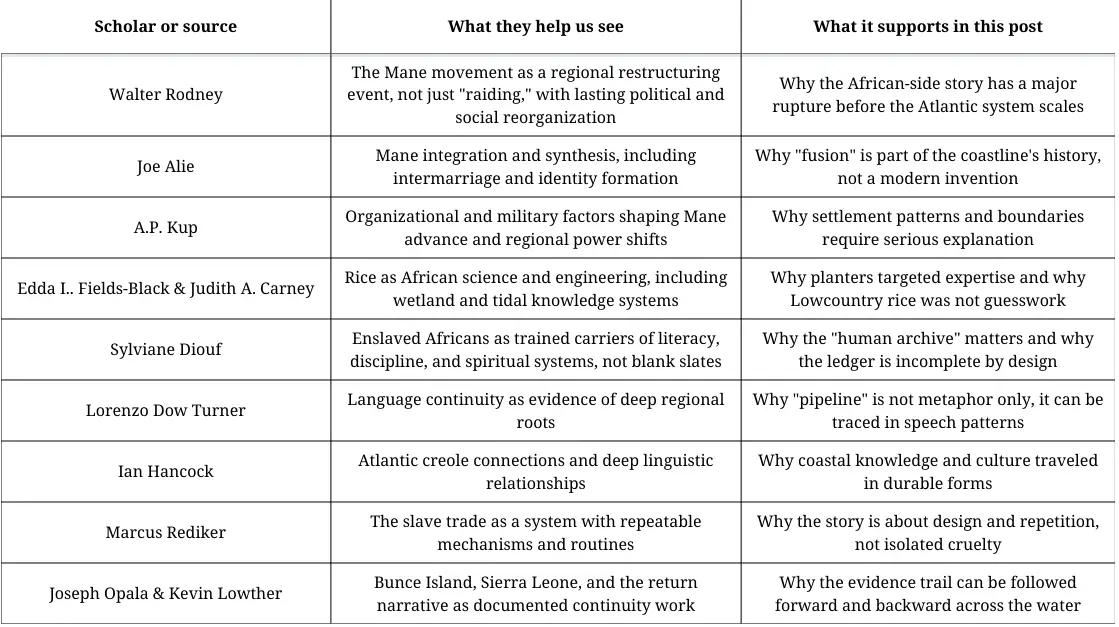
Historians such as Walter Rodney and A.P. Kup describe the Mane as a military and political force of Mande origin. They had strong organization and better iron weapons, and they moved into coastal areas, fighting local groups that early Portuguese sources sometimes called “Sapes.”
But the main story isn’t just about conquest. It’s also about blending and creating something new.
Scholars often describe the Mane as both integrators and conquerors. They married into local families and blended with coastal peoples. These encounters created new identities. The Mende are often cited as a main example of this process, in which disruption and blending shaped a new people.
I call this the first rupture, not because it was the only one, but because it taught the region how to adapt before the Atlantic trade later forced people to adapt through captivity.
3. What the rupture produced: the cultural software of the coast
Many historians say that the blending during the Mane era helped spread Mande-style governance and initiation systems, like Poro and Sande, to coastal communities. These weren’t just “secret clubs.” They acted as schools, governments, diplomatic groups, and ways to keep social order among different peoples.
This is important for the Gullah Geechee story because it shows that resilience was something inherited. Organization, leadership, careful knowledge protection, and ecological skill didn’t start in the Americas. They were brought over and adapted, even under watchful eyes.
You can still see traces of this in food traditions shaped by rice knowledge and in basket-making that keeps coastal skills and memories alive.
Three connected results come from looking at the story from the African side:
- Adaptation under a conqueror’s pressure, later applied under planter domination
- Poly-ethnic unity, the ability to fuse multiple peoples into a coherent identity, later mirrored in the Lowcountry making of “Gullah” as a people-forming process
- The rice engine, the hydraulic and ecological knowledge that later made Carolina rice possible, a transfer of uncredited genius
So when merchants later said they were buying “labor,” they were hiding the truth. They were actually buying people shaped by a coastal system, formed by earlier challenges.
4. The human archive: what the ledgers could not hold
This is where the evidence becomes even clearer.
Sylviane Diouf warns us not to think of captured Africans as blank slates. Many were Muslims, scholars, and highly trained initiates. Their literacy, ritual discipline, and moral authority acted as a living archive that survived even when written records did not.
A key example in this research is Bilali Muhammad, whose discipline comes from Mande and Fula Qur’anic schooling and whose legacy continues in the Georgia Sea Islands. The point isn’t fame—it’s ability. Plantation records listed bodies, but the people brought skills and training.
5. The scholar’s lens: a quick map of the evidence

6. The map question we must research honestly
One of the biggest questions in this African-side story is still unanswered:
If the Mane were a Mande-speaking expansion force, why did settlement and state-building influence consolidate mainly in Guinea, Sierra Leone, and Liberia, but not produce comparable settlement structures in Guinea-Bissau, Senegal, and The Gambia in the same way?
Scholars usually focus on three main explanations. One points to ecology and political resistance. Another highlights absorption and integration, meaning Mane influence may have blended into existing societies without leaving clear settlement patterns. A third explanation warns about limited records and European bias in documentation.
My view is mixed. The boundary probably comes from a mix of environmental factors, political structures, trade routes, and what the records did or didn’t mention. If you have sources that address this question, especially for Guinea-Bissau, Senegal, and The Gambia, I’d like to hear about them.
Author’s Note on Method
This post brings together an African-centered view that connects political change, ecological knowledge, institutional discipline, and lasting cultural traces. I see the Mane era not as a side note, but as part of the foundation that explains how expertise could be taken and used later.
I’ll keep testing this argument as the series continues. That means looking more at the “human archive”—what skilled people brought with them when there were no written records—and focusing more on the open question: why do Mane settlement patterns show up more clearly in Guinea, Sierra Leone, and Liberia than in Guinea-Bissau, Senegal, and The Gambia?
If you have sources or leads, please share them. I’m especially looking for research or primary evidence about Mane settlement boundaries and coastal integration in these less-documented areas. This is how we build a better record.
Why this matters now
The archive learned to use polite words. It made theft look like business and turned expertise into “labor.”
A strong image ends this African-side story. Breaks in the past shattered the calabash, first inland and then on the coast, but the seed still grew. That ongoing thread is real. It’s what survived both disruptions.
As America approaches its 250th year of independence, the real challenge isn’t just to celebrate. It’s to ask if we can finally be honest about the expertise this country took, used, and then pretended it never bought.
Reader prompt: Where do you see your origin story—at the auction block, or earlier, in the African systems that made survival possible?